
Your Attribution Model Is a Story You Tell Finance
-
 by Ben Liau
- May 31, 2026
- Growth Marketing
- 0

Your attribution model is a story you tell finance. It is not a map of what happened.
That reads like a cheap shot. It is the most useful thing you can understand about marketing reporting, because once you see it you stop making a whole category of expensive mistakes. The dashboard that splits last quarter’s revenue across channels to the decimal point looks like measurement. It is a negotiated settlement about who gets credit, printed in a typeface that makes it look like physics. Nobody is lying. The number was never a measurement in the first place.
Attribution is a choice, not a measurement
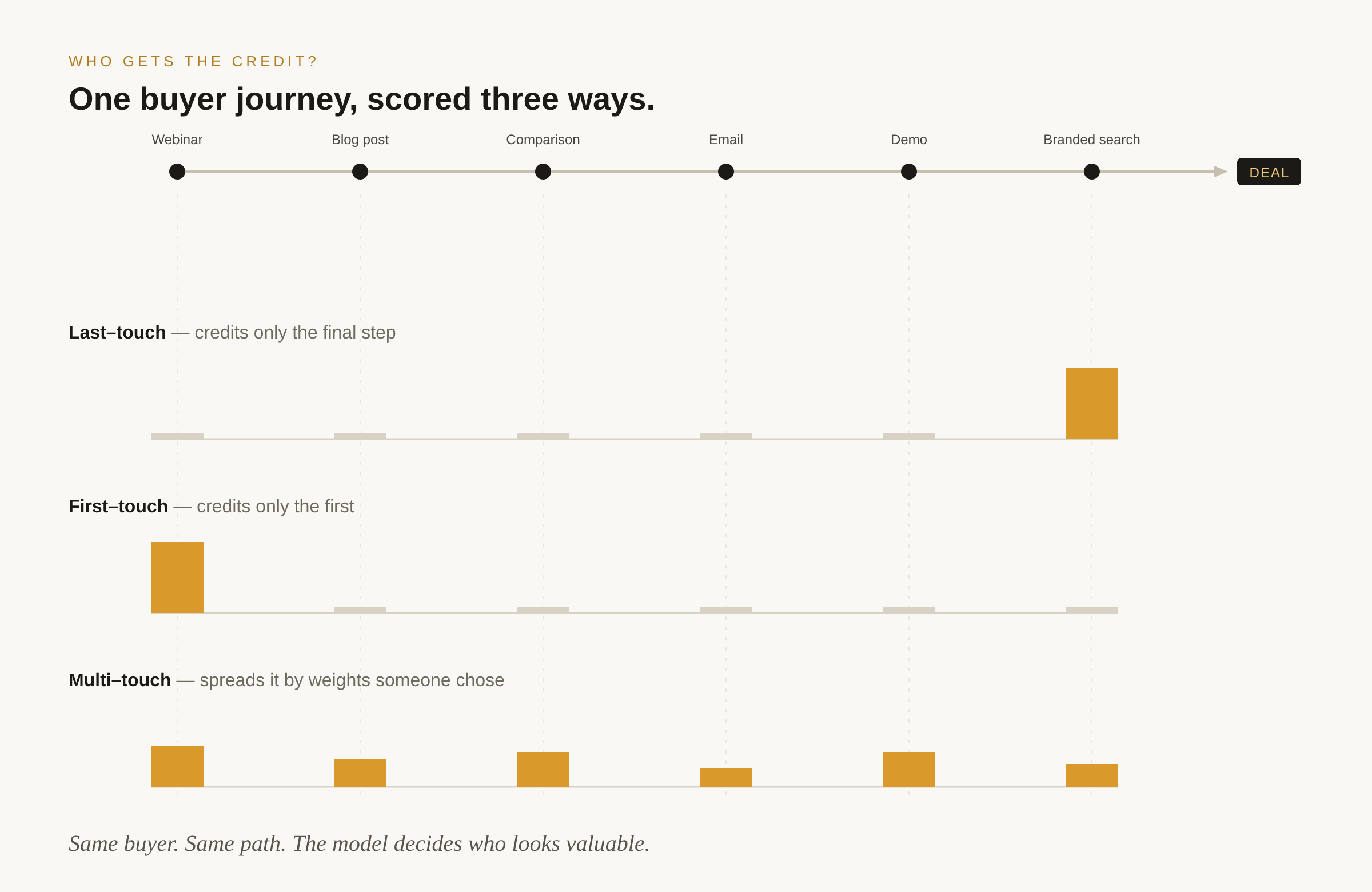
A buyer touches your brand a dozen or forty times before they turn into a deal. A webinar. Three blog posts a colleague forwarded. A competitor comparison read at 11pm. A badge scan at a conference. Two emails ignored and one opened. A demo. A procurement process you never saw. Then they buy.
Attribution’s job is to take that mess and split the credit across it. The part everyone skips: there is no correct way to do it. Last-touch hands all the credit to the final step, usually a branded search or a demo request. It flatters the bottom of the funnel and erases everything that built the demand. First-touch does the reverse. Multi-touch spreads the credit, but someone still chooses the weights. You decide the first touch is worth 40% and the last another 40%, or a model infers it from data that is itself full of holes.
Every one of these is a defensible editorial decision. None of them is a measurement. The moment you pick a model, you have picked which parts of your marketing to make visible and which to make disappear. You did it before you collected a single data point.
Nobody wants to fund the plumbing
So why does the story survive? Because the dashboard is what people ask for, and the plumbing underneath it is what nobody will pay for.
Everyone wants the report. Pipeline by channel, cost per lead by campaign, a clean attributed-revenue chart for the board. What they will not fund is the boring machinery that makes those numbers true: consistent tracking across every property, identity resolution so one human is not counted as four leads, a CRM where the fields actually get filled, a definition of a qualified lead that two teams agree on, and someone whose job is to stop all of it rotting.
None of that has a screenshot. You cannot present a well-governed campaign taxonomy and get a nod from the leadership team. So it goes unresourced, and the dashboard gets built on the gap anyway, because the dashboard was the deliverable. The result is not a missing number. It is a confident wrong one. A blank cell makes people ask questions. A precise, invented percentage makes them nod along. Broken plumbing never announces itself. It just quietly poisons every decision that drinks from it.
You fund what you can see, not what works
This is where the story stops being harmless and starts costing money.
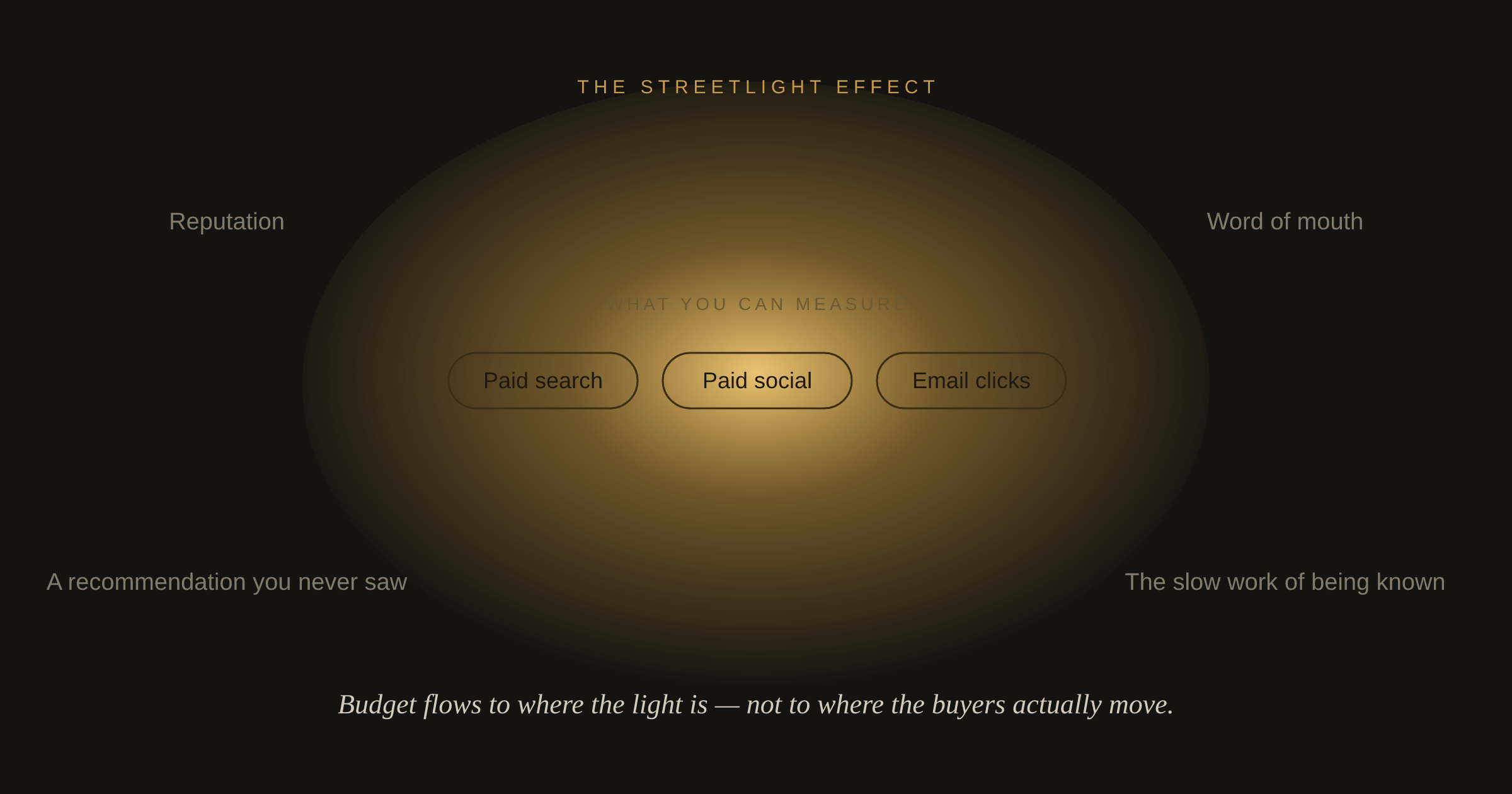
There is an old joke about a drunk looking for his keys under a streetlight. A passer-by asks where he dropped them. Over there in the dark, he says, but the light is better here. That is marketing measurement. The trackable channels sit under the lamp: paid search, paid social, anything with a click and a cookie. The things that actually move B2B buyers sit in the dark: reputation, a podcast half-remembered, a recommendation in a Slack group you will never see, the slow work of becoming known. They are real. They are often the biggest drivers. And they are close to invisible to attribution.
So budget flows to the measurable, because the measurable is what shows up in the report that defends budget. You feed the channel that attributed well, usually the bottom of the funnel, which was only harvesting demand that something upstream created. You starve the things that built the demand, because they cannot prove their case. Do that for two years and you optimise yourself into a smaller and smaller pool of easily-tracked tactics, wondering why growth went flat.
Then Goodhart’s law finishes the job: when a measure becomes a target, it stops being a good measure. Point a team at an attribution number and they will produce the number. More branded-search spend taking credit for demand it did not create. Lead volume that looks great and converts at nothing. The dashboard climbs while the engine seizes.
What honest measurement actually looks like
None of this means giving up and running on vibes. It means treating your numbers with the honesty they deserve, which is a sharper discipline than pretending they are precise.
Demote attribution from truth to direction. It is a forecast, not a thermometer. Fine for “paid social has been sliding for three months.” Useless for “paid social drove 14% of pipeline.” Report trends and ranges, and refuse to defend the decimals.
Be loud about your blind spots. The most credible person in the room is the one who says we cannot see word-of-mouth, or how our content moved deals that closed through sales, and both are probably large. Not the one with the tidiest pie chart. Naming what you cannot measure is what makes the rest of your numbers believable.
When a decision actually matters, run a holdout instead of asking the model. Turn a channel off in one region and watch pipeline. Geo-test. Compare exposed and unexposed groups. An experiment answers “does this work” in a way attribution structurally cannot, because it builds a world without the thing and measures the gap. More effort, less tidy, and the only version that survives contact with reality.
And fund the plumbing. The highest-leverage move most teams could make on their numbers is not a new attribution tool. It is clean tracking, resolved identity, agreed definitions, and governance that stops the whole thing decaying. Boring, invisible, and worth more than every model on the market.
The point was never better attribution
The goal was never a more accurate model. You can burn a year and a serious budget chasing one and still be telling finance a story, just a more expensive one with better graphics.
The goal is honesty about what you can and cannot know, and the nerve to act on it anyway. Hold attribution loosely. Say out loud what is hidden. Settle the big questions with experiments, not reports. Spend your credibility defending the plumbing, not the pie chart.
In the short term, that person looks less impressive than the one with the confident dashboard. They are also the one still making good calls in two years, while everyone else hunts for keys under a light they picked because it was convenient.