Most B2B Webinars Are Theatre, Not Pipeline
-
 by Ben Liau
- June 30, 2026
- Growth Marketing
- 0

Most webinars aren’t marketing. They’re a performance of marketing — and the most convincing part of the performance is the lead you capture at the end.
The honest defence of the webinar is exactly that. It isn’t just a talk; it’s a lead-gen engine. You run polls and surveys mid-session — are you evaluating a solution, what’s your timeline, what’s your budget — and you leave with a list of MQLs. That feels like an outcome. It’s the strongest case for the format, and it’s worth taking seriously.
It’s also where the theatre gets good. Because a marketing qualified lead is not an outcome. It’s an output with the word “qualified” stapled to it.
An MQL is a promise, not a result
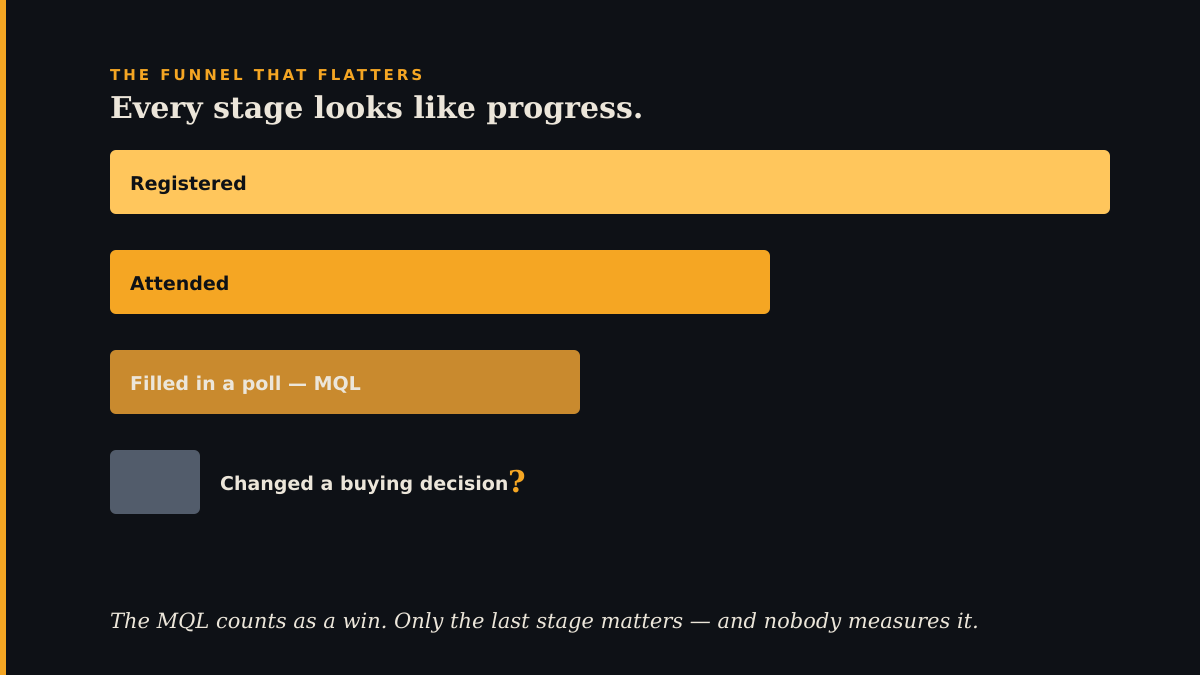
A marketing qualified lead is a prediction that someone might buy, made on the strength of a poll answer they gave while half-watching a slide.
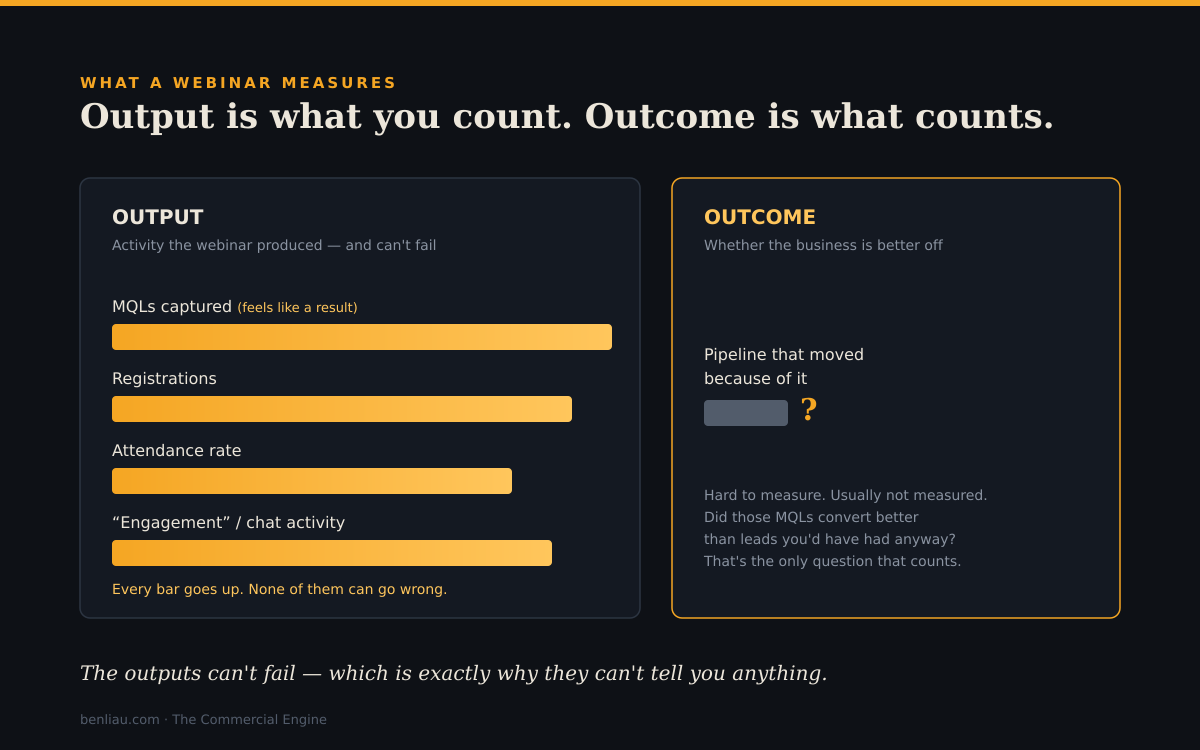
Look at what the poll actually measures. “Are you evaluating a solution this quarter?” records a click, not a commitment. The person idly browsing for ideas and the person with budget and a shortlist tick the same box. You’ve captured intent; you haven’t verified it. And the number — MQLs captured — goes up every time you run the webinar, which is the tell. Like registrations and attendance, it’s an output that can’t really fail.
This is the same confident-wrong-number problem behind bad attribution. A blank cell makes people ask questions; a precise count of “qualified” leads makes them nod. The count feels like proof precisely because it has a number next to it.
The honest question was never how many MQLs the webinar captured. It’s whether those MQLs became pipeline that wouldn’t have existed otherwise — and whether they did it at a rate that beats the leads you’d have had without running the webinar at all.
The lead sales doesn’t trust
Ask your sales team what they think of webinar leads. In most companies the answer isn’t printable.
That’s not bad luck. Low-friction capture produces exactly what you’d expect: a lot of leads, most of them cold. A poll that’s easy to answer is easy to answer carelessly, so the list comes out long and thin. Sales works the top of it, the rest ages quietly into the database, and the conversion rate — the one number that would tell you whether the webinar worked — goes unmeasured.
Capturing the MQL is the easy half. Proving it was worth capturing is the hard half, and it’s the half that usually doesn’t happen. A programme that counts MQLs and never checks what they turned into has just moved the theatre one layer down the funnel.
Here’s the test that cuts through it. For your last webinar, can you name a deal that progressed because of it — not an MQL it generated, a deal it moved, one you’d bet on if someone made you put money down? If the answer is a confident name, it worked. If the answer is a lead count, you’re looking at the output again, dressed up to look like a result.
What a webinar that isn’t theatre does
Capture the signal — then close the loop.
The poll isn’t the problem. A sharp question asked to the right audience is genuine intent data, and it’s worth having. The problem is stopping there. The non-theatre version treats the MQL as the start of the work, not the end of it: the signal gets routed to sales within hours while it’s warm, acted on, and then followed all the way to whether it closed.
Then you measure it like you mean it. Not MQLs captured — whether the people who attended converted better than comparable people who didn’t. That’s a holdout, and it’s more effort than a lead count and far less flattering. Plenty of webinar programmes wouldn’t survive it. The ones that do are worth keeping, and now you can prove it instead of asserting it.
And sometimes the answer is to not run it. “We decided a webinar wouldn’t move anything and did the harder thing instead” is a better quarter than six that filled the MQL dashboard and nothing else.
Running a webinar is easy. Capturing a lead from it is easy. Knowing whether either did anything is hard — and the easy halves quietly stand in for the hard one, until the whole programme is activity and lead counts with no revenue underneath them.
The test was never whether you can run a webinar or fill a list. It’s whether you’d be able to tell if it stopped working. Most programmes couldn’t. That’s the theatre.
Frequently asked
Are B2B webinars worth it?
Sometimes, but not by the usual scorecard. A webinar is worth it when it changes a specific buying decision for a specific group of buyers, and when the leads it captures convert to pipeline better than leads you’d have had anyway. Judged by registrations, attendance, or raw MQL count, most aren’t worth it — those are outputs that can’t fail.
What should you measure for a webinar?
Not registrations, attendance, “engagement,” or MQLs captured — those are output metrics that can’t fail. Measure the outcome: whether attendees progressed deals that comparable non-attendees didn’t, and whether the leads converted better than your baseline. The cleanest version is a holdout.
Don’t webinars capture MQLs that justify them?
Only if those MQLs convert. An MQL is a promise of pipeline, not pipeline — a poll answer, not a sale. Webinar leads are notoriously high-volume and low-intent, and most programmes never measure what they converted to. Capturing the lead is the easy half; proving it was worth capturing is the half that counts.