
The Org Chart Is About to Stop Matching the Work
-
 by Ben Liau
- July 26, 2026
- Growth Marketing
- 0

An org chart is a snapshot of what the tools couldn’t do on the day it was drawn.
The marketing department split into functions for a reason, and it wasn’t that the work is naturally four jobs. Demand generation, operations, content, analytics — those became separate seats because one person couldn’t physically hold all of it. The work was too manual, too slow, too much. So it got cut into pieces small enough for a human to carry, and each piece got a person.
That constraint is the thing that’s changing. Not the functions — the functions still matter — but the bandwidth limit that forced them apart. And when the reason a structure exists quietly disappears, the structure doesn’t collapse on its own. It just stops matching the work, and keeps being staffed anyway.
The department was a workaround
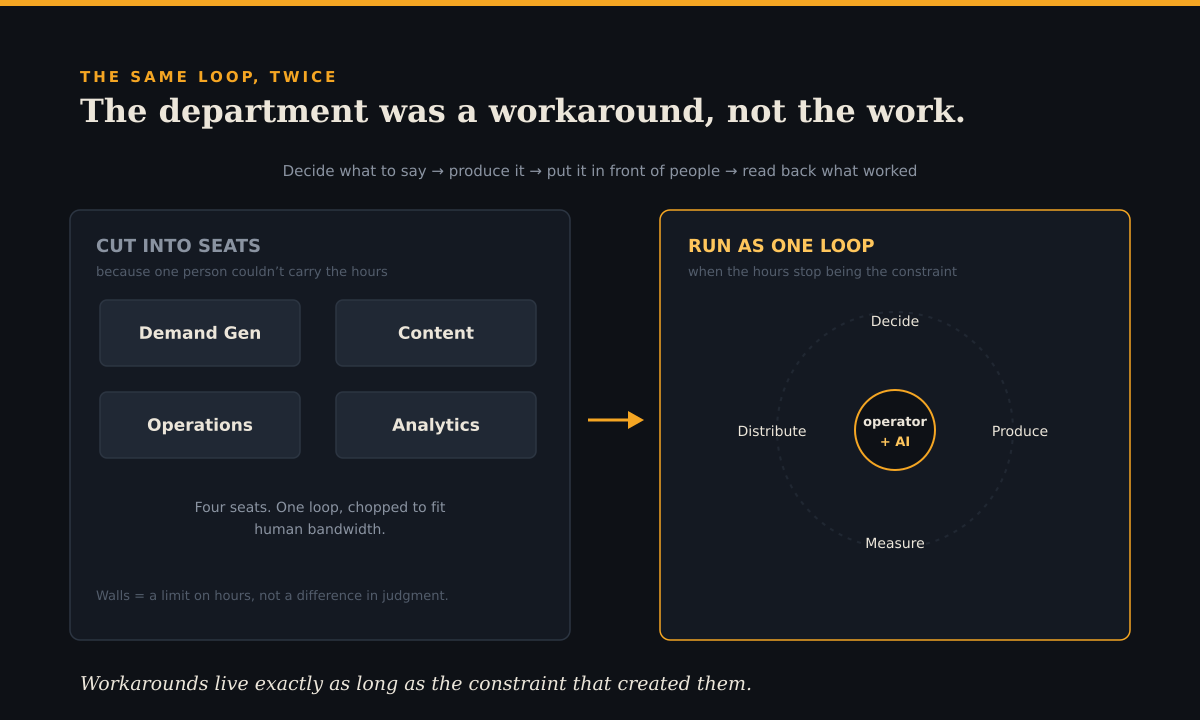
Start from first principles. What does a marketing function actually do? It decides what to say, produces the thing that says it, puts it in front of the right people, and reads back whether it worked. One continuous loop.
That loop got chopped into departments because each stage used to be a full-time grind. Someone had to hand-build the campaign in the platform. Someone had to write and version every asset. Someone had to stitch the data together from four systems that don’t talk to each other, and someone else had to turn that into a report before anyone could decide anything.
None of that division was about the thinking. It was about the labour. The walls between demand gen, ops, content and analytics weren’t drawn because those are different kinds of judgment — they’re the same judgment applied at different points in one loop. The walls were drawn because no single person had the hours to run the loop end to end.
Treat that as the key fact, because it is. The department structure was never the natural shape of the work. It was a workaround for how much one person could carry — and workarounds live exactly as long as the constraint that created them.
What actually compresses
The constraint is lifting because most of the labour in that loop was never the hard part. It was connective work — and connective work is exactly what AI collapses.
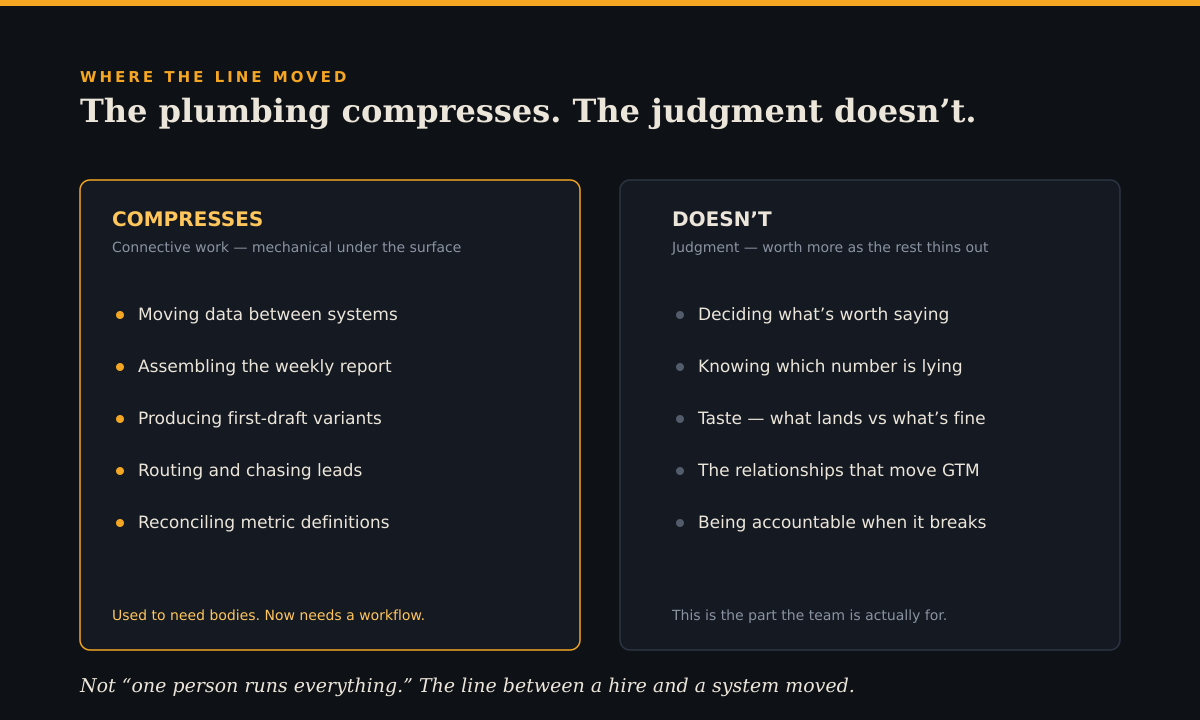
Look at where the hours actually went. Moving data between the CRM, the automation platform and the analytics tool. Assembling the same report every week. Producing the tenth first-draft variant of an email. Routing a lead to the right place, chasing the field nobody filled in, reconciling two definitions of the same metric. This is the plumbing of a marketing team, and it consumed most of its headcount. It was tedious, it was high-volume, and it needed bodies precisely because it was too manual to automate with the last generation of tools.
That’s the layer that compresses. Not because AI is clever, but because this work is mechanical dressed up as skilled — judgment-shaped on the surface, repetitive underneath. When the drafting, the assembling, the moving and the routing stop needing a person each, the loop can close in far fewer hands than it used to.
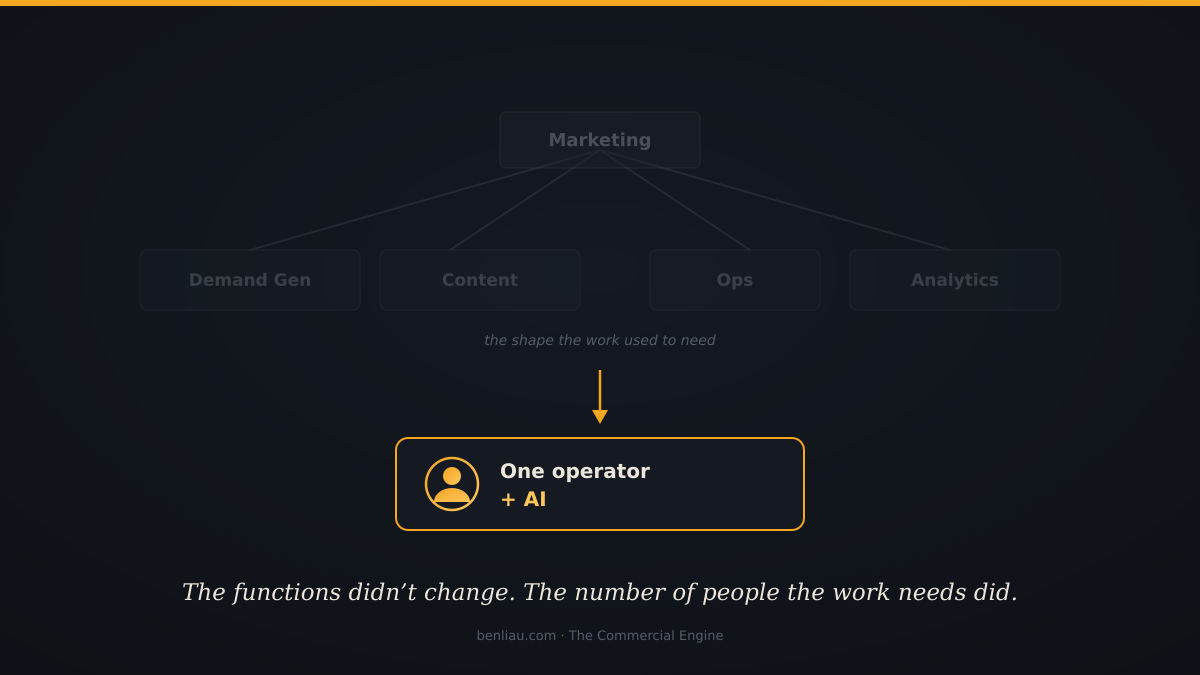
The unit that benefits isn’t a bigger department. It’s a smaller number of people who understand the whole loop, with the mechanical layer handled underneath them. One operator who can see demand gen, ops, content and measurement as a single system — and has the tools to run it as one — now covers ground that used to be four seats. That’s the direction the work is moving, across the industry, whether or not the org charts have noticed.
Hiring is still drawing the old shape
The structure is lagging the work, and hiring is where the lag shows.
Watch how the typical marketing gap gets filled. A function feels stretched, so someone scopes the role, writes the req, and waits a quarter for a hire — a hire described in the vocabulary of the old constraint. “Marketing ops manager.” “Content coordinator.” “Reporting analyst.” Each of those titles is a fossil of a bandwidth limit that may no longer bind.
The reflex skips the only question worth asking first: is this a people problem or a system problem? Often the team doesn’t need another pair of hands on the plumbing. It needs the plumbing to stop requiring hands. But “hire someone” is legible, fundable and safe, while “rebuild the workflow so the role isn’t necessary” is none of those things — so the req goes out, and the old shape gets reprinted for another two years.
This is an industry pattern, not a verdict on any one team. Most marketing orgs are still hiring against a constraint that’s quietly lifting, because the org chart updates far more slowly than the tools do. The gap between the two is where the opportunity sits.
What doesn’t compress
This is the point where the argument usually overreaches, so let me not.
The mechanical layer compresses. The judgment on top of it does not. Deciding what’s actually worth saying, and to whom. Knowing which number is lying. Taste — the difference between a competent asset and one that lands. The relationships that make a go-to-market actually move. Someone accountable when it goes wrong. None of that collapses, because none of it was ever the plumbing. If anything it becomes more valuable, because it’s the part that’s left.
So this isn’t “one person runs everything.” That’s the hype version, and it’s wrong. The real claim is narrower and more durable: the line between what needs a hire and what needs a system has moved, and it’s still moving. Work that used to justify a seat now often justifies a workflow instead. The team doesn’t vanish — it gets denser, fewer people each holding more of the loop, with the machine doing the carrying underneath.
I’ll be honest about where I stand on this, because the credibility matters more than the claim. I’m building toward this, not reporting it finished. I’m testing how far the loop actually collapses in practice, what breaks when it does, and where the judgment layer turns out to be thicker than it looked. What I’m describing is the direction and the reasoning, not a department I’ve run single-handed with receipts to wave. When I have those receipts, I’ll show them. Until then this is a thesis I’m willing to defend, not a result I’m pretending to own.
The org chart won’t announce that it’s out of date. It’ll just quietly describe a constraint that no longer exists, while the work reorganises underneath it.
The teams that notice first won’t look lean. They’ll look like they’re ahead — shipping more than their size should allow, with a headcount nobody can quite explain. That’s not a smaller version of the old shape. It’s a different shape, and it’s being drawn right now by whoever stops reprinting the old one.
Frequently asked
Will AI replace marketing teams?
No — it replaces the mechanical layer inside them, not the judgment on top. The work that compresses is the connective plumbing: moving data between systems, assembling reports, producing first drafts, routing leads. Deciding what to say, reading which numbers matter, and owning the outcome don’t compress. Teams get denser, not absent.
What does a lean marketing team look like?
Fewer people who each understand the whole loop — strategy, production, operations and measurement as one system — with AI handling the repetitive connective work underneath them. It’s not one generalist doing everything; it’s a small number of operators holding more of the loop each, because the manual labour that used to require separate seats no longer does.
Should you stop hiring for marketing roles?
Not stop — ask a different question first. Before scoping a req, separate the people problem from the system problem: does the team need another pair of hands, or does the workflow need rebuilding so those hands aren’t required? Often it’s the second, and hiring just reprints an org shape built for a constraint that’s lifting.