The Skills Worth Getting Good At When AI Does the Rest
-
 by Ben Liau
- October 7, 2026
- Growth Marketing
- 0

The skill that made you valuable in commercial work is quietly becoming the skill a machine does for free. That is not a threat. It is a map.
For most of the last decade, a marketing career was built on execution. Could you run the campaign, build the report, write the email sequence, wire up the platform so the data actually flowed. The people who could do those things faster and more reliably were the ones who got promoted. AI is now doing that layer, cheaply, at volume, and it gets better every month.
So the ground is moving under the whole idea of what a skilled operator is. The abilities that felt like the foundation are turning into the commodity. The abilities that used to sit on top, the ones that were harder to name and harder to teach, are becoming the thing that actually separates people. This is about which of those skills are worth getting good at now, while the shift is still early enough to be an advantage rather than a scramble.
The flip
Think about what the old ladder actually rewarded. Proficiency at the task. You got good at running paid campaigns, or building the reporting, or writing sequences that converted, and that proficiency was the asset. It took years to build, it was scarce, and it paid.
AI collapses the price of that proficiency. It will draft the sequence, assemble the report, spin up the campaign structure, and reconcile the data, in minutes, for almost nothing. None of it is perfect, but it is fast, cheap, and endlessly available, and that is enough to turn a scarce skill into a utility. The thing you spent years getting good at is becoming something you can rent by the token.
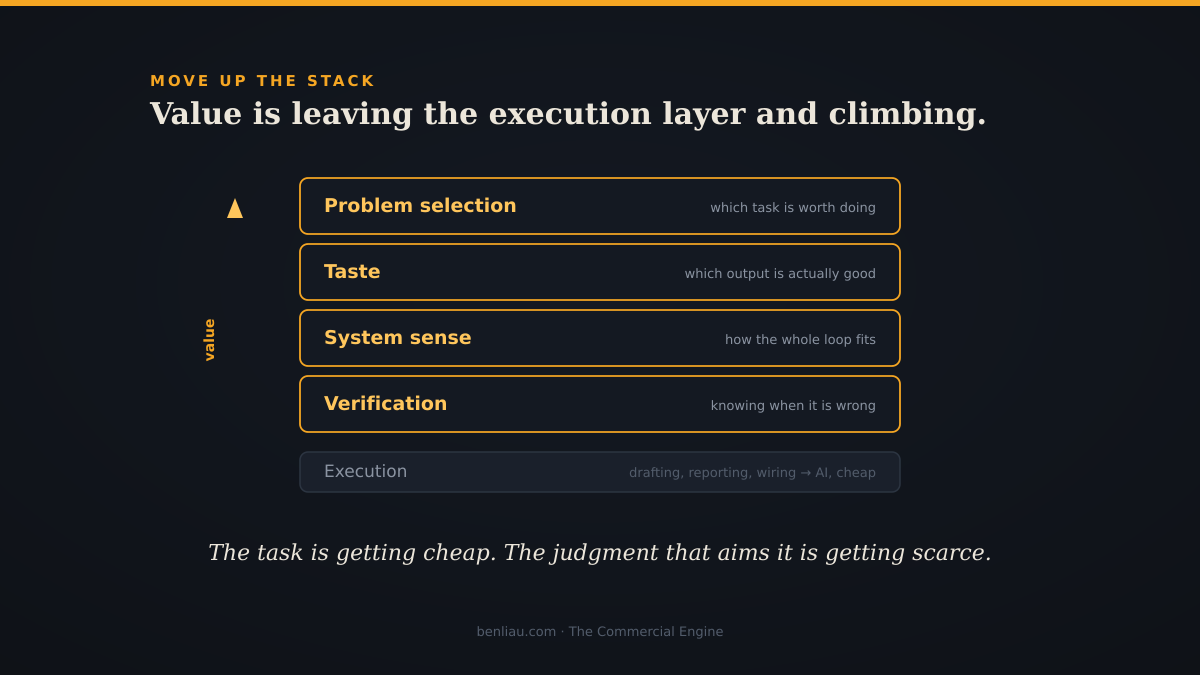
That is the flip, and it is worth saying plainly. Value is moving from “can you do the task” to “do you know which task is worth doing, and can you tell whether the output is any good.” The doing is getting commoditised. The choosing and the judging are not. Everything useful about where to point your career from here follows from that one sentence.
Four skills that are quietly appreciating
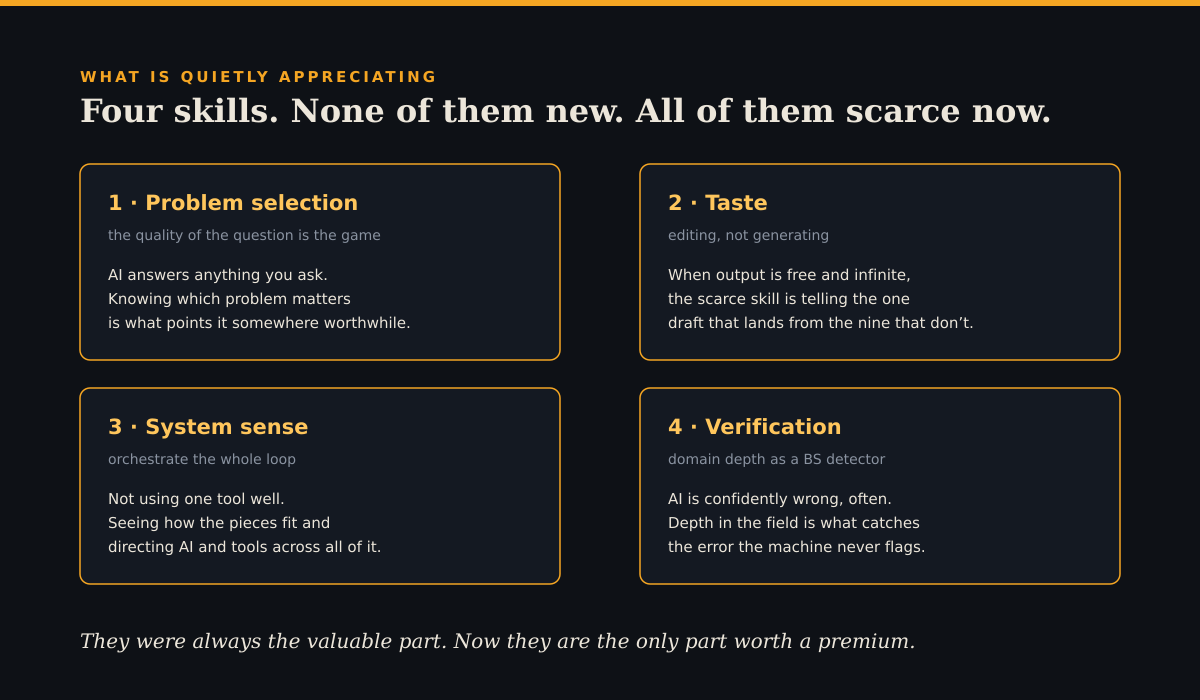
If the execution layer is going cheap, the question is what sits above it. Four things, and none of them are new. They were always the valuable part. They are just becoming the only part worth paying a premium for.
Problem selection. AI will answer almost any question you bring it, which makes the quality of the question the whole game. Knowing which problem actually matters, and which one just looks urgent, is the skill that decides whether all that cheap execution gets pointed at something worthwhile or wasted at high speed. A team that can generate a thousand campaigns and cannot tell which one is worth running has not been helped by AI. It has been handed a faster way to be busy.
Taste. When output was expensive, you ran a few options and picked one. When output is free and infinite, the bottleneck moves to judgment of quality. The scarce skill becomes the ability to look at ten plausible drafts and know why nine are mediocre and one lands, or why all ten miss. That is taste, and it is editing rather than generating. The generator is now a commodity. The editor is the one who makes it good.
System sense. The real leverage is not using one AI tool well. It is seeing the whole commercial loop as a system and designing how the pieces fit: what feeds what, where the handoffs are, which parts to automate and which to hold back for a human. The person who can orchestrate the tools and the models across the full loop is worth far more than the person who is fluent in any single one of them.
Verification. AI is confidently wrong on a regular basis, and it never signals which parts to doubt. So the ability to catch the error becomes a core skill, and it rests on something that cannot be prompted: genuine depth in the domain. Knowing the field well enough to feel when a number is off, a claim is too clean, or a recommendation is subtly wrong is the thing that keeps cheap output from becoming expensive mistakes. Domain depth stops being about doing the work and becomes a detector for when the machine is lying to you.
What is losing its edge
The honest flip side is that some genuinely hard-won skills are losing their premium, and it is worth naming them without pretending otherwise.
Raw execution speed on commodity tasks is the clearest one. Being the person who could turn around the deck, the report, or the fifteen ad variants fastest used to be a real advantage. It is becoming table stakes, because the machine is faster and does not get tired. Tool-specific proficiency is the next one. Deep fluency in a particular platform was worth a lot when the platform was hard and the knowledge was scarce; as AI learns to drive those tools, knowing every menu stops being a moat.
None of this means that work was ever fake, or that the people who built careers on it wasted their time. That proficiency is what built the judgment underneath, and you cannot get the second without first doing the first. The point is not that execution was worthless. It is that execution is no longer where the next decade of advantage lives, so it is a poor place to keep investing the bulk of your attention.
How you actually build them
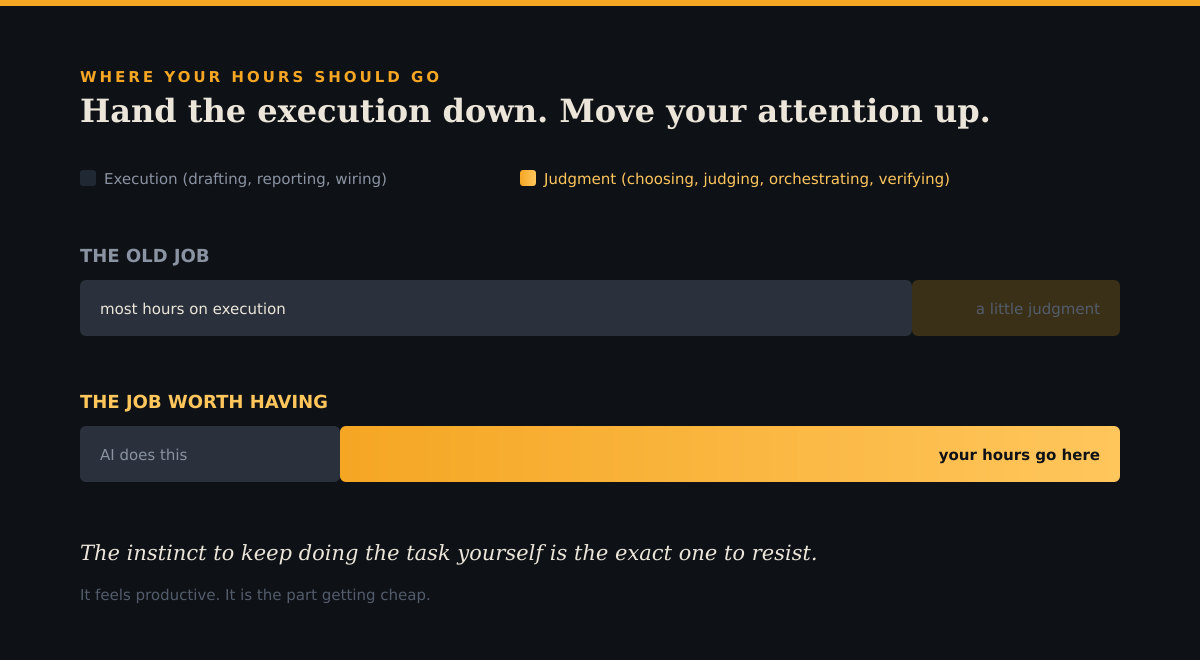
The awkward thing about the appreciating skills is that none of them come from a course. You cannot certify your way to taste or buy a workshop in judgment. They are built the slow way, which is exactly why they are becoming scarce while everyone else chases the quick credential.
Taste comes from producing and critiquing a lot of work, and from studying things that are genuinely good until you can articulate why they work. Judgment comes from reps and from the post-mortem on what went wrong, which is the same engine that makes experience compound: you do not learn it by running more things, you learn it by understanding why the last thing died. System sense comes from actually wiring pieces together yourself, breaking the loop and fixing it, until you can see how the whole thing moves rather than just your corner of it. And verification comes from depth, which means staying close enough to the real work to keep your instincts calibrated, even as the machine does more of the doing.
The practical move follows from all of it. Spend your scarce hours deliberately on the judgment layer, and hand the execution layer to AI on purpose, rather than clinging to execution because it is familiar and legible and produces something you can point to. The instinct to keep doing the task yourself, because that is what you are good at and it feels productive, is the exact instinct to resist. The task is the part that is getting cheap. Your attention is better spent on the part that is getting valuable.
There is a version of this moment that reads as loss, and I understand why. The thing you got good at is being handed to a machine. But the skills moving to the top of the stack are the more interesting ones to own anyway: choosing what matters, telling good from merely plausible, designing how the whole system fits, and knowing when the answer is wrong. That was always the senior part of the job. It was just buried under the execution that paid the bills.
The people who thrive from here will not be the ones who resist the tools, and they will not simply be the ones who adopt them fastest. They will be the ones who move up the stack to the work the machine cannot do. That work was always the valuable part. AI is just making it the only part worth being paid for.
Frequently asked
What marketing skills will AI not replace?
The ones above the execution layer: choosing which problem is worth solving, judging whether output is actually good, designing how the whole commercial system fits together, and catching the errors the machine makes. AI is excellent at producing work and poor at deciding what is worth producing or whether it is right. Those judgment skills are where durable value is moving.
How do you stay valuable as AI takes over execution?
Move up the stack on purpose. Spend less of your time on the tasks AI now does cheaply (drafting, assembling, reporting) and more on the parts it cannot: problem selection, taste, orchestration, and verification. The trap is clinging to execution because it is familiar and visible. The task is getting cheap, so your attention is better invested in the judgment that aims it.
Are tool and technical skills still worth learning?
Yes, but for a different reason than before. Deep fluency in one platform is no longer a moat, because AI increasingly drives the tools for you. What stays valuable is enough technical and domain depth to orchestrate the system and to verify the output, which means staying close to the real work so your instincts stay calibrated. Learn tools to build judgment, not to be the fastest operator of a menu.