Winning Search Means Owning Data the Models Can’t Get
-
 by Ben Liau
- April 29, 2026
- Growth Marketing, SEO
- 0

The old way to win search was to write the best answer to a question and rank for it. That game is ending, and more blog posts will not save it.
The reason is simple. When someone asks a question now, an AI increasingly gives them the answer directly, assembled from everything it has already read. They get what they needed and never click. The page you optimised so carefully is sitting one layer below a machine that already summarised it, and the visit you were counting on does not happen.
So the winning move has changed shape. It is no longer about having the best page about a topic. It is about owning data about that topic the model cannot get anywhere else. The question stopped being whether you can write about something and became whether you know something the machine cannot find.
The traffic is getting intercepted
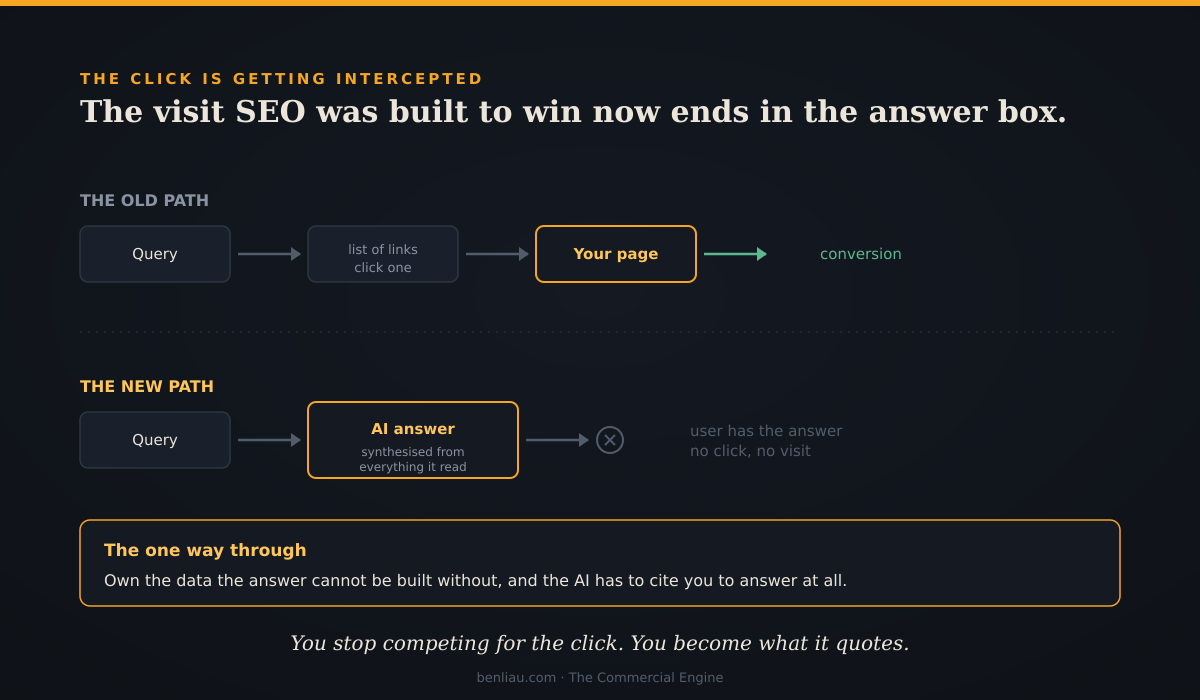
To see why, look at what actually happens to a query now versus five years ago.
The old path had a gap you could stand in. Someone typed a question, got a list of links, clicked one, landed on a page, and maybe converted. Every step of SEO was built to win that click: rank higher, write the better page, capture the visit. The whole discipline assumed the user had to leave the search box and go somewhere, and your job was to be the somewhere.
The new path closes that gap. Someone asks a question, the AI reads across everything it has absorbed, and it hands back a synthesised answer in the box itself. For a large and growing share of queries, that is the end of the journey. There is no list to rank in, no click to win, no page to land on. The visit SEO was built to capture is being intercepted one level up, at the answer.
And this is the part worth sitting with: publishing another good blog post into that world does almost nothing. The model has already read a thousand good blog posts on your topic. Yours is one more drop in an ocean it already drank. You are adding to the training set of the thing that is replacing your traffic.
Why “just publish more” loses
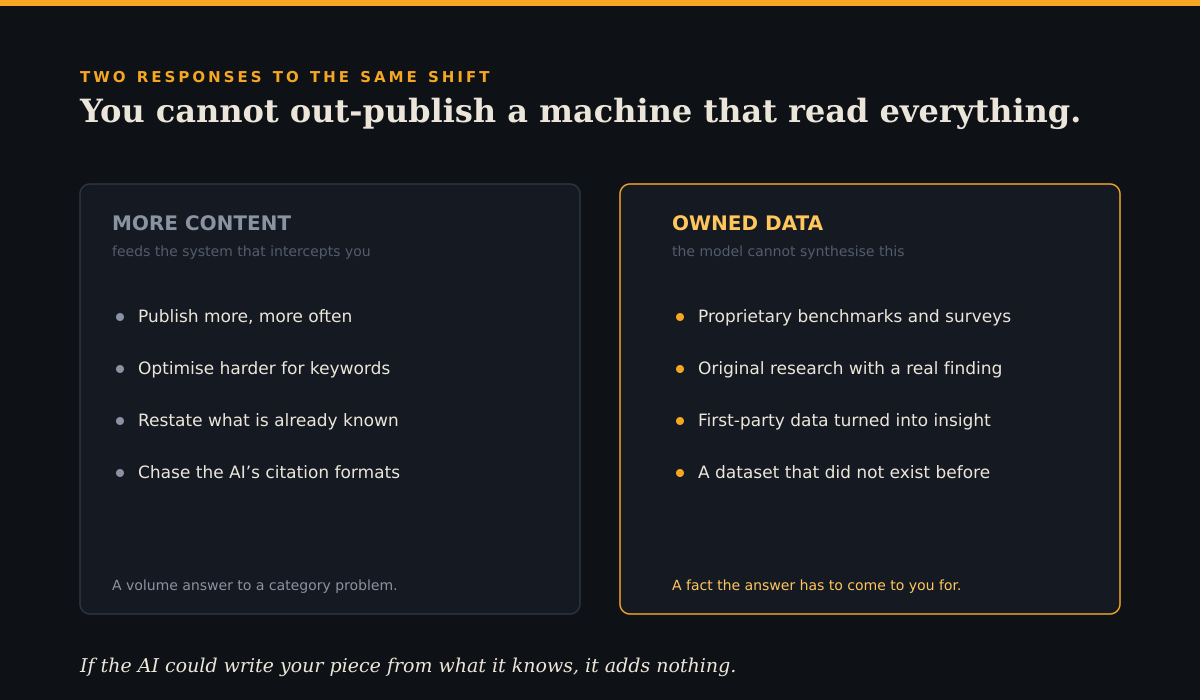
The reflex response to all this is to do more of the old thing. Publish more often, optimise harder, study how to get cited by the AI, chase the formats it seems to favour. It feels like action, and it is almost entirely wasted.
Here is the logic that kills it. If the model can already assemble a solid answer from the commodity content that exists, then your next post, however well made, changes the answer by nothing. You are competing to be one more interchangeable source of information the machine already has in abundance. Content that restates what is broadly known is precisely the thing AI is best at absorbing and reproducing, which means the better you are at that old game, the more directly you are training your own replacement.
You cannot out-publish a machine that has read everything. That is not a volume problem you can solve with a bigger content calendar. It is a category problem. As long as what you produce is a rearrangement of what is already out there, you are feeding the system that intercepts you, no matter how much of it you make.
Own what the model cannot reach
The way through is to stop competing on the layer the machine owns and move to the one it cannot.
Models are built from what is public and already written down. That is their strength and their blind spot. They are extraordinary at reproducing what has been said and completely blank on what has not. So the moat is information that is not in the training set and cannot be synthesised from it: proprietary data, original research, real numbers from inside an operation, a benchmark nobody else has gathered, a dataset that did not exist until someone built it.
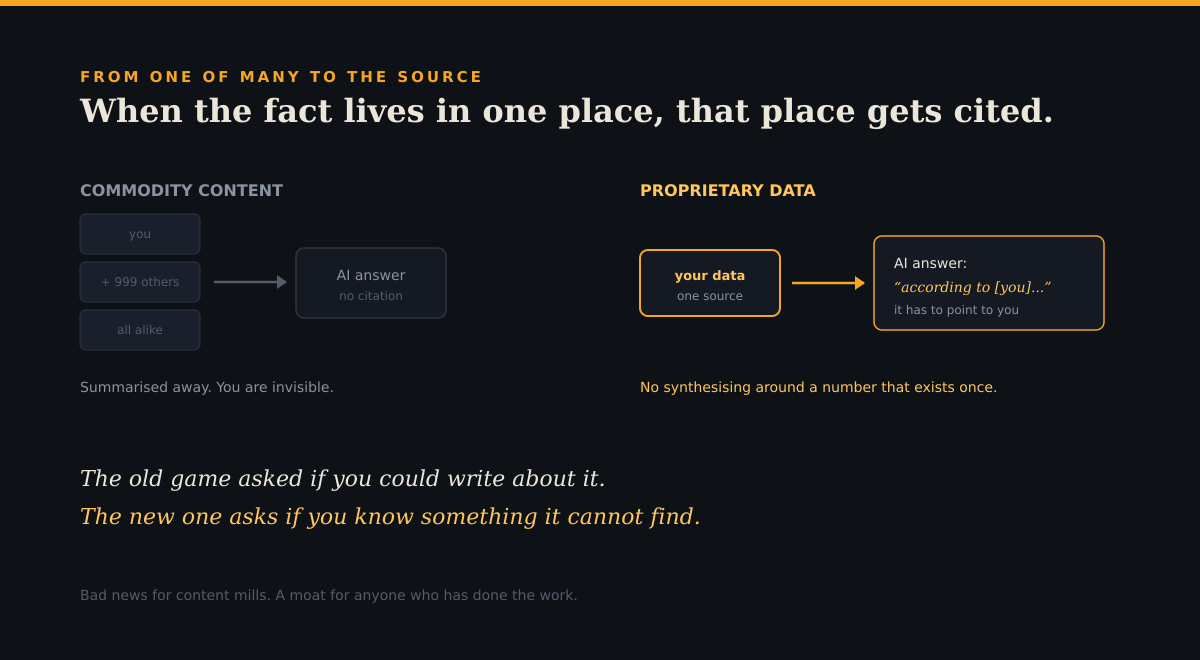
When the answer to a question can only come from you, the whole dynamic inverts. The AI is no longer summarising you out of the picture. It needs you, because you are the primary source and there is no synthesising around a number that exists in one place. You stop being one of ten interchangeable pages about a topic and become the thing the answer has to cite. That is a position no amount of commodity content can buy, and it is the one worth building toward.
What that looks like in practice
This is abstract until you make it concrete, so here are the forms it tends to take.
Proprietary benchmarks and surveys: data you can gather from your market or your customers that nobody else is positioned to collect, turned into a reference point people need. Original research and analysis: a real question investigated properly, with a finding that was not sitting on the internet beforehand. First-party data made public: the patterns inside your own operation, anonymised and shared as insight that only your vantage point produces. Tools and calculators that generate their own data: something people use that, in the using, creates numbers that exist nowhere else. And the quietest one, lived operational truth: the specifics of how something actually works, documented by someone who has run it, which almost nobody writes down honestly.
The common thread runs through all of them. Each creates information that did not exist before you made it, and that the model cannot assemble from anything else. You are not writing a better version of a known answer. You are producing a new fact that the system has to come to you for.
The bar just went up, and that is good
It is worth being honest that this is harder than the thing it replaces, and that the difficulty is the whole point.
The old SEO was open to anyone with a keyboard and a content calendar. You could rank by being diligent, publishing consistently, and out-working the next content team, with no requirement that you actually know anything first-hand. The new game has a tougher entry fee. It asks you to have something true and unique, or to go and generate it, before you have anything worth publishing at all. You cannot fake a benchmark you did not gather or research you did not do.
That higher bar is bad news for content mills and good news for operators. If being worth citing now requires real data and real experience, then the people with real data and real experience just got a moat they did not have before. The field is tilting away from whoever can produce the most words and toward whoever actually knows something. For anyone who has done the work, that is the best news in a decade.
Search is not dying. It is being re-sorted, and the sort is ruthless. Everything that was a rearrangement of common knowledge is collapsing into the answer box, and everything that is a genuine, hard-to-get fact is becoming more valuable, because it is the one thing the machine cannot manufacture.
So the question to carry into the next few years is not whether you can write about your topic. It is whether you know something about it that the machine cannot find anywhere else. Get that, and you are no longer competing with the AI for the click. You are the thing it quotes.
Frequently asked
Is SEO dead because of AI?
Not dead, re-sorted. The part of SEO that was about ranking a page that restates common knowledge is collapsing, because AI now answers those queries directly in the box and the click never happens. The part that rewards genuinely unique, hard-to-get information is becoming more valuable, because that is the one thing the model cannot generate on its own.
How do you get cited by AI in search?
By being a source the answer cannot be assembled without. Models reproduce what is already public, so you earn a citation by owning information that is not: proprietary benchmarks, original research, first-party data, numbers that exist in only one place. When the only source for a fact is you, the AI has to point to you. Chasing citation formats and publishing more commodity content does not achieve this; having something unique does.
What content still works in the age of AI answers?
Content built on something the model cannot reproduce. Original research, proprietary data turned into insight, tools that generate their own numbers, and the lived specifics of how something actually works, documented by someone who has done it. The test is simple: if the AI could write your piece from what it already knows, it adds nothing; if your piece contains a fact that did not exist until you produced it, it is exactly what wins now.